TL;DR: After 2.5 years, we crossed 50% mortgage paid, $189K principal eliminated, $300K+ interest saved. We eliminated 18 years from our original timeline through a simple strategy: extra principal payments whenever possible, consistent tracking, and unwavering commitment to mortgage freedom.
I remember it like it was yesterday—a few weeks before closing on our home, watching almost every YouTube video on how to pay off a mortgage faster. Not in 25 years. Not in 20 years. Before the standard 30-year sentence.
You see, since relocating to the United States 11 years ago, I had never carried consumer debt month-to-month. But all that was about to change. And I hated it with every fiber of my being.
I was born free and wanted to remain that way. But I needed this loan. So the decision became crystal clear: get the loan, expedite the payments, and become debt-free in 5-7 years.
I sat down with my then-fiancée now wife to discuss the situation. I told her, "If we get this loan, this is the timeframe we need to pay it off. I don't know exactly how, but I think it's reasonable, and if we're true to ourselves, we can make it happen."
She was on board.
Now, for the strategies.
Our Strategy: The Art of Extra Payments
From all my research on YouTube, TikTok, Reddit, and ebooks, one approach stood out as most effective: applying extra payments directly toward the principal. Not once a year. Not once a quarter. Not once a month. But rather whenever we had extra funds available that we wanted to apply to the principal, we just did it.
What Didn't Work: The Biweekly Payment Myth
Many people have advocated for biweekly payments. I investigated this approach thoroughly. Here's what I discovered:
The Reality: 98% of lenders don't apply the first half of a biweekly payment until the second half is received. This means the loan balance doesn't actually reduce until both halves arrive—no interest savings whatsoever. The supposed benefit dissolves under scrutiny.
My Decision: This strategy was out.
What I Considered: Velocity Banking
Next, I explored velocity banking strategy. On the surface, it seemed plausible.
The Concept: Get a HELOC with a variable rate, then move chunks of money from the HELOC to your mortgage. Reduce HELOC interest by parking your paycheck there. Use your credit card for 90% of expenses, then pay the card from the HELOC at month-end. Repeat this cycle while also paying down your mortgage.
The Reality I Discovered: This strategy involves constant financial juggling—multiple accounts, variable rates, credit card cycling, and meticulous cash flow management. The mental overhead is substantial.
Here's what matters: This approach might work brilliantly for someone who thrives on complex financial optimization. But for me, the system felt unnecessarily complicated. I needed a strategy that protected my peace of mind, not one that required financial gymnastics. The peace of mind wasn't worth the complexity trade-off.
My Decision: I crossed this strategy off my list and never looked back.
What Worked: The Extra Payment Strategy
So with the simple extra payment strategy toward principal as our foundation, our approach took clear form:
On a Monthly Basis:
- Round our mortgage payment: From $2,175.98 → $2,500.00 (constant $324.02 extra payment every month)
- Apply side gig income: Ride-share (Lyft), financial coaching, IT troubleshooting—whatever generates extra cash
- Direct surplus budget amounts: Any leftover from our monthly budget goes straight to extra principal payments
- Round the loan balance: At month-end, we round the balance to the nearest tenth or hundredth, eliminating decimals (Example: $235,673.89 → $235,600.00)
- Apply windfalls: Birthday gifts and Christmas money → principal
On a Yearly Basis:
- Annual bonuses: Both my wife and I receive yearly bonuses from our primary jobs. When we do, we apply 80% toward the principal
- Tax refunds: Whenever we receive state or federal refunds, we apply them to the principal
The Tracking Method That Changed Everything
I only knew one tool for tracking: Excel. So I got to work creating a mortgage worksheet from scratch, ready to use from day zero after closing.
I lived in that spreadsheet for days and months, fine-tuning formulas, testing scenarios, and refining the tracking system.
The result? Consistent visibility of every extra payment and a real-time view of our accelerated timeline.
I couldn't un-hear this phrase:
"What gets tracked gets managed. What gets managed gets done."
It made so much sense to me. Inputting extra payments multiple times a month, watching the balance drop steadily from $378,000 to $188,800 in 2 years and 5 months—it's nothing short of amazing.
The numbers today:
- ✅ Over $300,000 saved in interest
- ✅ 18 years eliminated from our original timeline
- ✅ 50% paid off (we just crossed the halfway mark today - Dec 3, 2025)
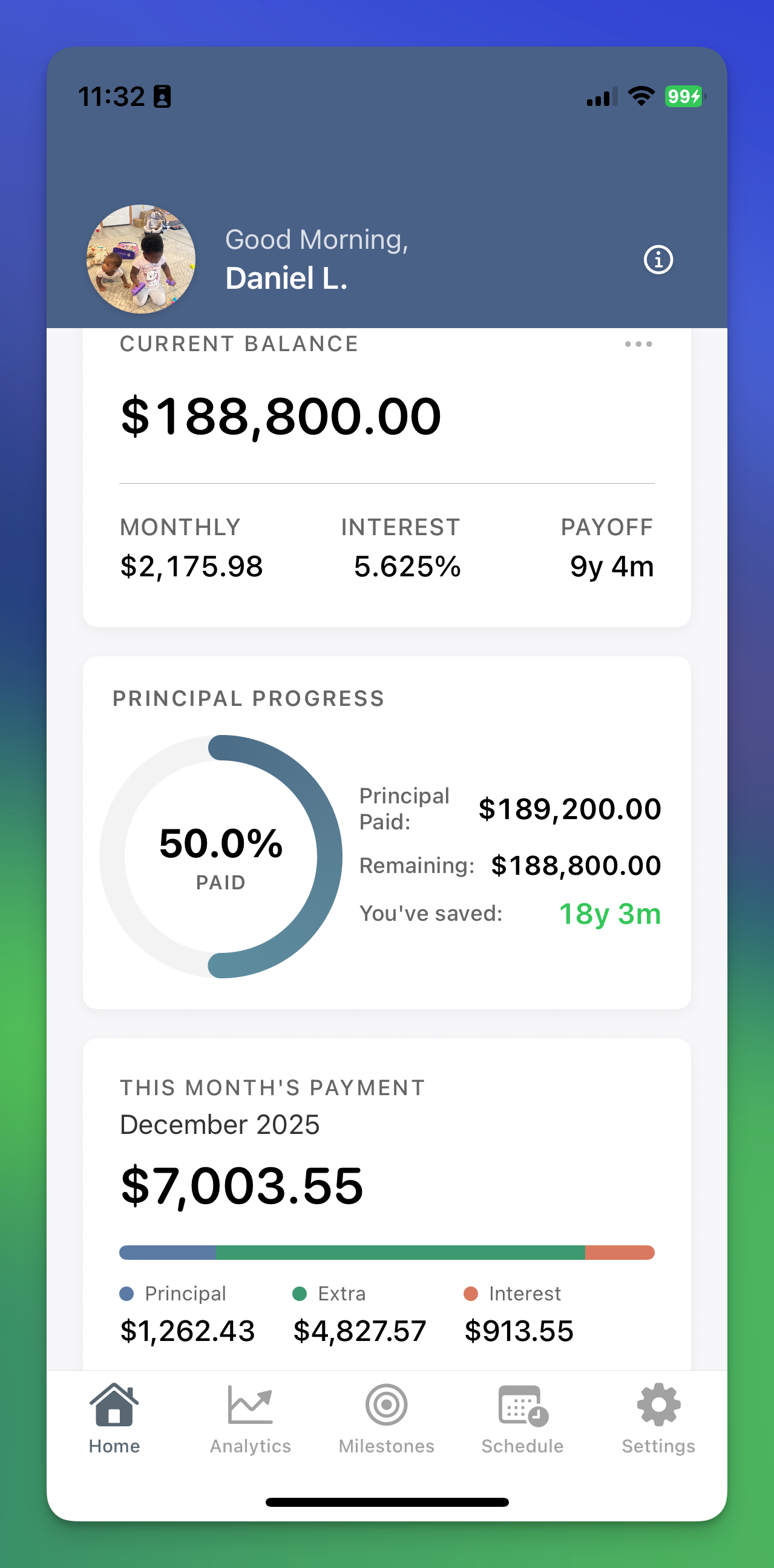
This milestone feels significant. I needed to memorialize it.
The Lessons I've Learned on This Journey
We Started Debt-Free (And That Made All the Difference)
As I mentioned, I came into this mortgage journey without consumer debt—no student loans (my wife has one, which we'll tackle after the mortgage), no car loans, no BNPL schemes, nothing of that sort.
This made it significantly easier to direct extra funds toward our mortgage. I'm not sharing this to brag, but to be transparent about our starting position. It was a privilege that enabled our aggressive payoff strategy.
Our Balanced Financial Foundation
Here's the full picture of how we balanced mortgage acceleration with other financial priorities:
Emergency Fund:
- One year's worth of expenses in a high-yield savings account
- This gave us peace of mind to be aggressive with mortgage payoff
Retirement Savings:
- Both contributing to 401(k) to capture the full employer match
- Maxing out Roth IRAs annually
- We're not sacrificing our long-term financial security to pay off the mortgage
Quality of Life:
- Occasional restaurant meals
- Vacations every 2 years
- Small luxuries that make life enjoyable
The Philosophy: We're comfortable sacrificing a little now to ensure we live debt-free and give our daughters (ages 2 years 10 months and 11 months) a home with no mortgage burden by the time they're 7 years old.
The "Invest vs. Pay Off Mortgage" Debate
I know there are those who advocate investing instead of paying off a mortgage. I respect that perspective entirely. Here's mine:
This goal isn't forever. We have a specific 5-7 year timeline. Once the mortgage is gone, all that extra payment capacity flows directly into investments—compound growth, index funds, the full portfolio we envision.
For now, the peace of mind from eliminating debt and the guaranteed "return" of avoiding 5.625% interest feels right for our family.
Final Words: We Make Our Own Luck
We make our own luck, but sometimes being prepared is what ensures we have the capability to tap into the opportunities that come our way.
I've been budgeting using YNAB and saving since 2014 when I got my first job in the USA. I saved every single month without fail. I lived within my means consistently.
I lived in New York briefly, then moved to New Jersey to be closer to my job (no car needed). The apartment I stayed in was a walk-up 1 bedroom apartment with $800/month rent in 2016. By the time I got married in 2023 and moved into our home, my final rent was around $1,200/month.
I meal-prepped and packed my breakfast and lunch to work 95% of the time since I started working. These weren't sacrifices that felt painful—they were aligned with what I wanted: financial freedom.
I like to enjoy my peace of mind. I'm grateful for this journey so far.
Through all of this, I was fortunate enough to create an app to help others track their extra principal payments and visualize the impact. No one should normalize any kind of debt—not a 7-year car loan, not a 30-year mortgage, not even a 5-month personal loan.
Here's my challenge to you: Pay at least an extra $20 or $50 more than the minimum monthly amount. Just that small act lessens the total interest paid dramatically.
The Numbers Tell the Story
For a $535,000 home purchase where we put down 29% and received a loan for $378,000 at 5.625% for 30 years:
- Original total interest: $405,353.93
- Original total repayment: $783,353.93
- Current total interest: ~$91,683.08
- Interest saved: $313,670.85
- Years regained: 18
I didn't accept the standard mortgage narrative, and neither should you.
For New Homeowners: Set the Foundation Right
New homeowners have the opportunity to understand the true cost of debt and do much better—if they choose to. Here's what I'd tell anyone closing on a home:
- Set the foundation right from day one
- Be consistent with extra payments
- Adjust your lifestyle intentionally (not resentfully)
- Live debt-free—it's a great feeling
Overall wisdom: Do the things that improve your well-being and make you happy. Don't live to impress people that don't give a shit about you and don't care. That's the real freedom.
We're halfway there. No stopping me now.
About the Author
Daniel is a homeowner, financial coach, and creator of PayOff Pro—an iOS app designed to help you track mortgage acceleration and visualize your path to debt freedom. He lives in New Jersey with his wife and two young daughters.
Want to accelerate your mortgage payoff? Download PayOff Pro to track every extra payment and see your progress in real-time. Get Started Now
Disclaimer: Calculations are my close estimates for illustration purposes and may not reflect your exact loan terms. Consult your lender for precise figures. This content is educational and not financial advice. PayOff Pro helps you track your mortgage; always verify important financial decisions with your lending institution before taking action.