On July 30, 2026, Freddie Mac put the average 30-year fixed at [6.66 percent][5], the highest reading in about a year.
For most homeowners, that settles it. The rate-and-term refinance is off the table, and it has been off the table for a while now. Waiting for 4 or 5 percent is not a strategy. It is a delay, and the delay has a price that shows up every month.
What the rate story leaves out is that a lower rate from a lender is not the only way to cut what a mortgage costs. There is a second lever, it sits entirely on your side of the table, and nobody has to approve it.
Call it the internal refinance. Same loan, same rate, same terms. Different schedule.
The front-loaded years
A 30-year mortgage is not a flat deal spread evenly across three decades. It is heavily loaded at the front, and the first years are the expensive ones.
Take a $400,000 loan at 6.66 percent. Principal and interest comes to $2,570.51 a month.
The first payment splits like this:
- Interest: $2,220.00
- Principal: $350.51
That is 86 cents of every dollar going to the lender before you own another inch of the house. Across the first five years the picture barely improves, because you will have paid about $129,356 in interest against about $24,874 of principal.
Run it the full thirty years and the interest alone comes to $525,383. Total repaid on $400,000 borrowed: $925,383.
None of that is a trick. It is how amortization works. It is also why the front of the loan is where extra money does the most damage to the bank's math.
How the internal refinance works
No closing costs. No credit pull. No appraisal. No paperwork.
You send money directly to principal, above the required payment.
Interest is charged on the balance that remains, so every dollar of principal you retire early permanently erases the interest that dollar would have carried for the rest of the term. The effect compounds, and this time it compounds in your direction.
Here is what that looks like on the same $400,000 loan at 6.66 percent.
| Extra to principal each month | Time saved | Interest saved |
|---|---|---|
| $100 | 3 years 2 months | $66,689 |
| $200 | 5 years 8 months | $116,482 |
| $300 | 7 years 7 months | $155,461 |
| One extra payment per year | 5 years 9 months | $117,970 |
Two hundred dollars a month buys back five years and eight months of your life.
What a real refinance would have to beat
Compare that to the thing everyone is waiting for, honestly.
Say rates fall a full point and you refinance into a fresh 30-year at 5.66 percent. Your payment drops by about $259, to $2,311.47. Total interest over the new term: $432,130. Against staying put, that saves $93,253.
Two hundred dollars a month, with no refinance at all, saves $116,482.
The refinance buys a smaller payment. The extra principal buys years. They are two different purchases, and only one of them is available to you this month.
Point to note, because this is not an argument against refinancing. If rates do fall far enough to clear your closing costs, take the refinance, and then keep sending the payment you are making today instead of pocketing the difference. On that same loan, refinancing to 5.66 percent while continuing to pay $2,570.51 a month retires the balance in 23 years and 6 months with $323,333 in interest, which beats every other option on this page. The two levers work together. One of them just does not require anyone's permission.
The part that actually breaks
The math is simple. Staying with it is not.
Thirty years is too abstract to feel. An extra $50 lands like a pebble in an ocean. Your balance barely moves, and nothing your servicer sends you will ever mention that the pebble erased a few hundred dollars of future interest.
That is not a discipline problem. It is a feedback problem, and behavior that produces no visible result does not survive a busy month.
Where PayOff Pro comes in
PayOff Pro exists for that gap. It does not move your money and it does not connect to your bank. It shows you what your money is doing.
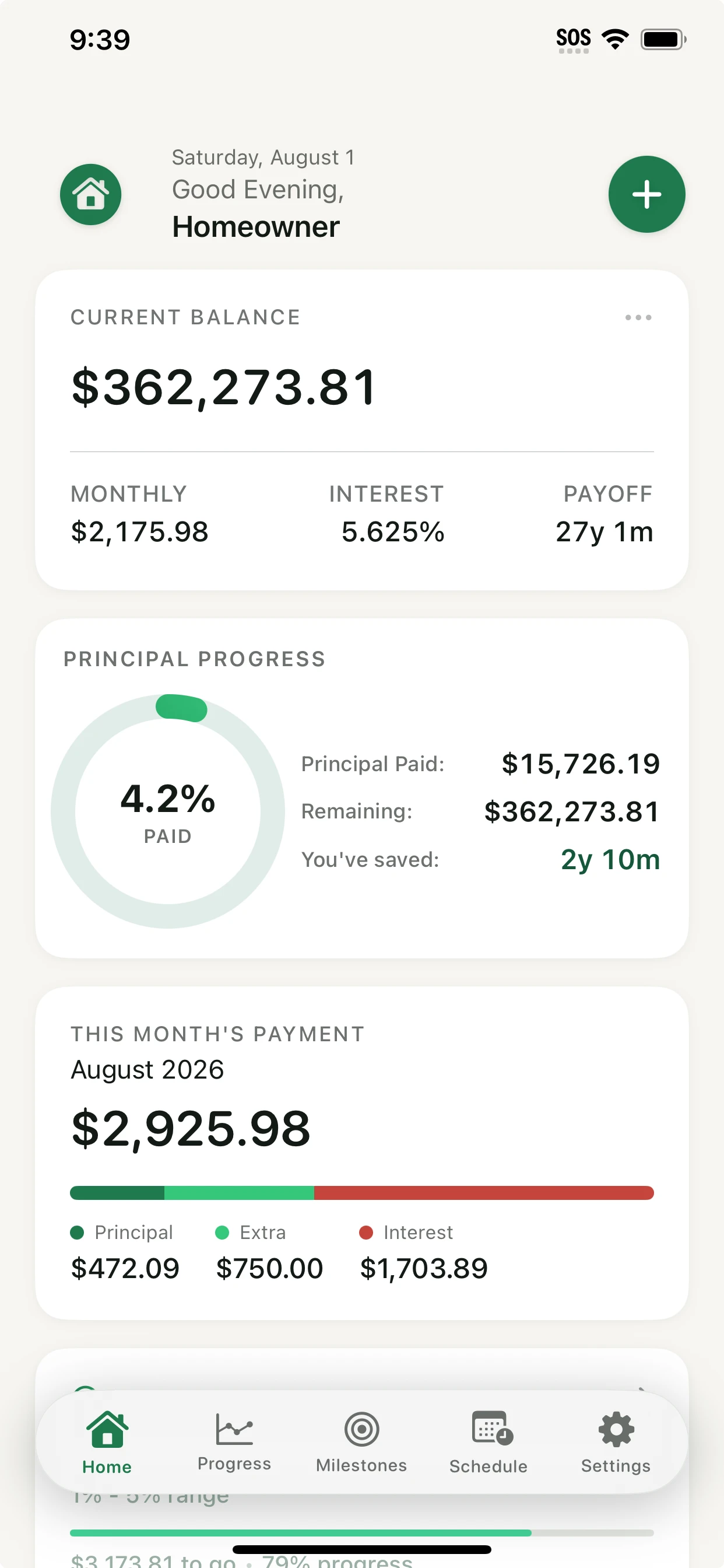
- The full interest picture. What your current schedule costs over the life of the loan, to the cent.
- A payoff date that moves. Log an extra $50 or an extra $2,000, whenever you can, and watch the projected date step closer in real time.
- What-if scenarios. Test a tax refund, a bonus, or a small recurring addition before committing a dollar, and see which one buys the most years.
- Home and lock screen widgets. The payoff date sits on your phone screen, so the progress stays in front of you without opening anything.
Watching a payoff date move from 2056 to 2048 does something a bank statement never will. It turns a chore into a scoreboard.
There is no account to create, no sign-in, and no tracking of any kind. Your loan stays on your device.
Three ways to start this month
- Round the payment up. If your principal and interest is $2,570.51, set the auto-payment to $2,700. You will not feel the $130. The loan will.
- Decide where windfalls go before they arrive. Half of every bonus, refund, or side payment to principal. Spend the other half without guilt.
- Confirm it lands on principal. Tell your servicer in writing that extra funds are principal-only, not a prepaid next payment. This varies by lender and it is worth the call.
The bottom line
You cannot control what the survey says next Thursday. You cannot control whether the refinance you have been waiting for ever arrives.
You can control the schedule you signed, and unlike the rate, that part was never actually settled.
If you want to watch your own payoff date move every time you send an extra dollar, PayOff Pro runs that math on your iPhone: [Get PayOff Pro for iPhone →][1]
3-day free trial, then $9.99 a year or $2.99 a month. No account required, and your loan stays on your device.
Related articles
- [Pay Off Your Mortgage Early: Forget the Rate Chatter][2]
- [Mortgage Recast vs. Extra Payments: Comfort or Years Back?][3]
- [Invest or Pay Off Your Mortgage? It Is More Than Math][4]
Disclaimer: All figures illustrate a $400,000 loan at 6.66 percent on a 30-year term, with no taxes, insurance, or fees included, and your terms will differ, so verify every number against your own statement before acting. Refinance comparisons ignore closing costs, which vary widely and can change the result. Prepayment rules and how a servicer applies extra funds vary by lender and loan type, so confirm your extra payment reaches principal. This is educational content rather than personalized financial advice, and I am not a financial advisor. PayOff Pro keeps your data on your device, which means your numbers never reach me or anyone else.
[1]: https://apps.apple.com/app/payoff-pro/id6752794539 [2]: /blog/pay-off-your-mortgage-early-forget-the-rate-chatter [3]: /blog/mortgage-recast-vs-extra-payments-comfort-or-years-back [4]: /blog/invest-or-pay-off-your-mortgage [5]: https://www.freddiemac.com/pmms