TL;DR: The proposed 50-year mortgage promises to make homeownership "affordable" by lowering monthly payments by $273. The reality? You'll pay $486,017 MORE in interest, that's $1,910 in extra interest for every $1 you save monthly. Most borrowers would die before owning their home. Here's the math you need to know and 8 better alternatives that actually help build wealth.
The Pitch That Sounds Too Good to Be True
In the complex world of mortgage products, the newly proposed 50-year mortgage is being marketed as a "game-changer" for affordability. Lower monthly payments. Easier qualification. The American Dream within reach. Do we still have that dream?
But what if this isn't solving the problem—it's creating a 50-year trap?
I wish i knew how these ideas get passed around for it to be supported. To begin with, a 30 year mortgage is even being frowned upon let alone 50 year mortgage? This got me thinking about how financial products are marketed versus their mathematical reality. And when I ran the numbers, what I found was shocking—even by industry standards.
Imagine a mortgage strategy that:
- Lowers your monthly payment by $273
- Keeps you in debt for 50 years
- Costs you an additional $486,017 over the loan life
- Takes 28.7 years to build 20% equity
- Ensures you're still making payments at age 90
Sound like a nightmare disguised as a dream? It is.
The Maths You Should Know
Here's the deal: The 50-year mortgage isn't about helping you own a home. It's about banks collecting interest for two additional decades while you're trapped in permanent debt. Lets assume you are still in active employment or even alive to begin with.
Let's break down the real numbers on a $400,000 mortgage at 7% interest:
The Comparison That Changes Everything
30-Year Mortgage (Current Standard):
- Monthly payment: $2,661
- Total interest paid: $558,194
- Total cost: $958,194
- Time to 20% equity: 12.8 years
- You own your home at age: 60 (if you buy at 30)
50-Year Mortgage (The Proposal):
- Monthly payment: $2,388
- Total interest paid: $1,044,211
- Total cost: $1,444,211
- Time to 20% equity: 28.7 years
- You own your home at age: 80 (if you buy at 30)
The Trap Revealed:
- You "save" $273 per month
- But you pay $486,017 MORE in total interest
- That's $1,910 in extra interest for every $1 saved per month
- Your first payment? 96.9% goes to interest (you're essentially renting from the lender)
Pro Tip: When a financial product promises to make something "affordable" by extending the timeline to 50 years, ask yourself: Who really benefits? The answer is always the lender, never the borrower.
Understanding the Foundation: How This Trap Works
The 50-year mortgage operates on a simple principle: minimize monthly payments by maximizing the loan timeline. But here's what that actually means for your financial life:
The Equity Building Disaster
With a 30-year mortgage, you own 20% of your home in 12.8 years. That's real wealth building—you can refinance, sell, or leverage that equity.
With a 50-year mortgage, reaching 20% equity takes 28.7 years. If you're 30 when you buy, you'll be 58.7 years old before you own a meaningful stake in your home. Most of your working life will be spent essentially renting from the bank.
The Numbers at Key Milestones:
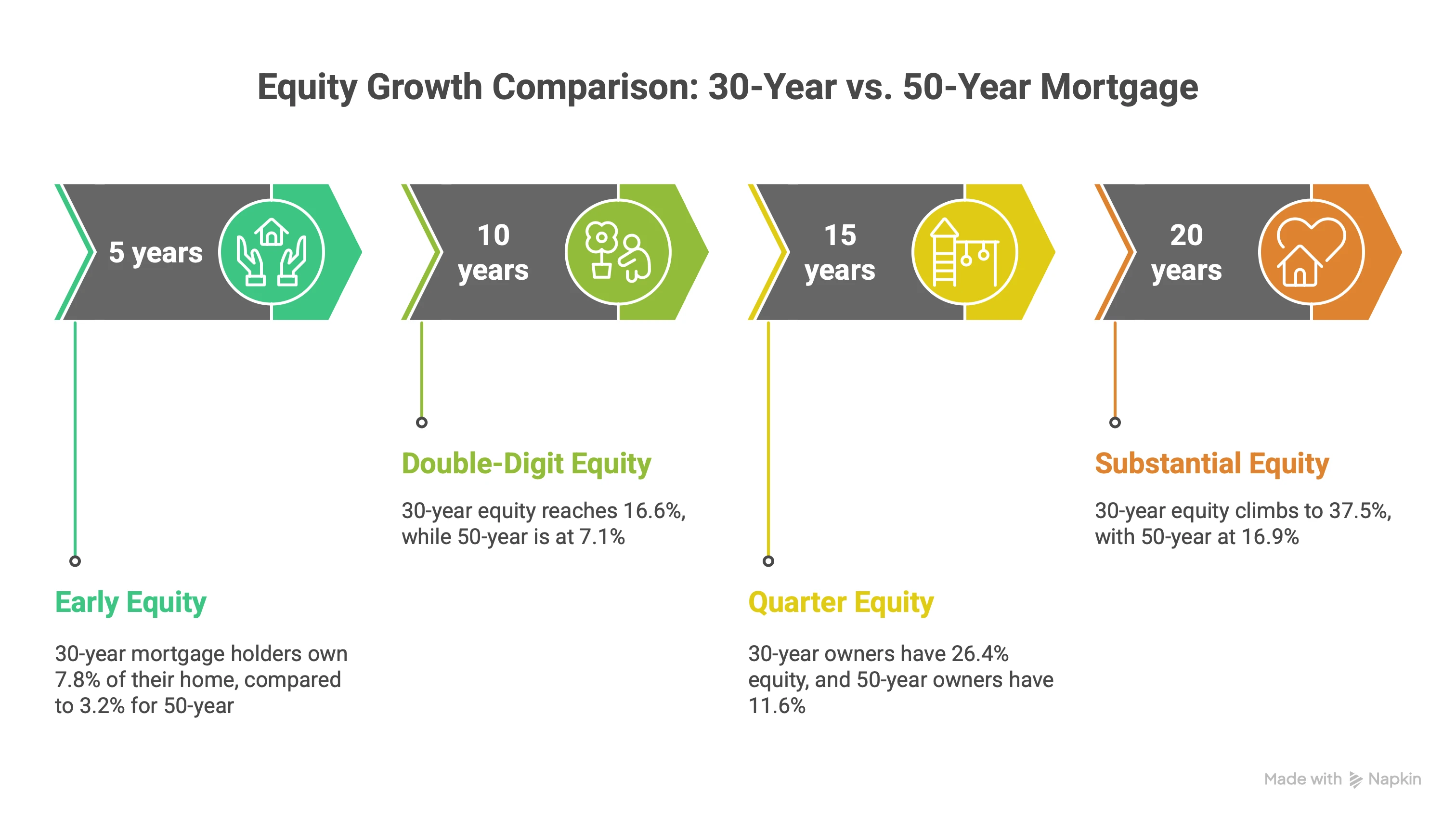
The Life Timeline Reality
Let's be brutally honest about what a 50-year mortgage means for your actual life:
- Buy at age 30? You own your home at 80 (if you live that long)
- Buy at age 35? You own your home at 85 (hope you have good genes)
- Buy at age 40? You own your home at 90 (most people won't see this day)
This isn't homeownership. This is permanent debt servitude disguised as the American Dream.
Why This Works (For lenders, Not You)
Here's what you should know: The 50-year mortgage is brilliant financial engineering—for banks and lenders.
Follow the Money
What Banks Gain:
- 20 additional years of interest payments
- 87% more interest collected over loan life
- Reduced default risk (lower monthly payment = easier to pay)
- Mortgage-backed securities with extended income streams
- Borrowers trapped with nowhere to go (switching costs too high)
What You Lose:
- $486,017 in additional interest (using the 400k example)
- Nearly 16 extra years of debt
- Slow equity building (can't refinance or sell easily)
- Retirement destroyed (still paying at age 70, 80, 90)
- Generational wealth opportunity eliminated
Pro Tip: Whenever a financial product primarily benefits the institution selling it while 'trapping' the consumer for decades, run the other direction. Fast!
The Not so 'Affordability'
They call it an "affordability solution." But here's the truth: A product that costs you nearly half a million dollars more isn't making anything affordable—it's making it expensive while feeling less painful month-to-month.
Real affordability means building equity, owning assets, and creating wealth. The 50-year mortgage does none of these things.
The Japan Warning: We've Seen This Movie Before
Let's talk about what happens when 50-year mortgages become normalized. We don't have to guess—Japan already ran this experiment.
Japan's 50-Year Ordeal
In the 1980s, during their real estate bubble, Japan introduced 50-year mortgages as an "affordability solution." Sound familiar?
The Results:
- Seniors trapped in unpayable mortgages, working into their 70s and 80s
- Parents unable to retire because of mortgage debt
- Banks introduced 100-year "intergenerational" mortgages—debt you inherit from your parents
- Contributed to Japan's "Lost Decades" of economic stagnation
- Created a generation that never owned their homes despite decades of payments
This isn't theoretical. This is documented economic history showing exactly what happens when long-term mortgage products become normalized.
Do we really want to import this disaster?
8 Better Alternatives (That Actually Work)
Here's the good news: You don't need a 50-year mortgage to achieve homeownership. You need better strategies. Let me walk you through what actually works.
1. Increase Your Income Instead of Extending Your Debt
The Strategy: Focus your next 12-24 months on increasing earning power instead of locking into 50 years of debt.
How to implement:
- Upskill in your current field (certifications, training)
- Negotiate a raise (market rate research + performance documentation)
- Side income streams (freelancing, consulting in your expertise)
- Career pivot to higher-paying industry
Why it's better: A $10,000 salary increase gives you $833/month more—three times the "savings" of a 50-year mortgage—without the $486K trap.
2. Down Payment Assistance Programs (Available Now)
The Reality: $2.8 billion in down payment assistance funding exists today. 2,466 programs nationwide. Most first-time buyers don't know about them.
How to access:
- Visit HUD.gov's local assistance finder
- Contact state housing finance agencies
- Explore employer-assisted housing programs
- Check local nonprofit housing organizations
Why it's better: Reduces loan amount = less interest paid. Many programs offer grants (free money) or forgivable loans.
3. Government-Backed Loans with Low Down Payments
Available today, no legislation needed:
- VA Loans: 0% down for veterans (no PMI)
- USDA Loans: 0% down for rural properties
- FHA Loans: 3.5% down for most buyers
- Conventional 3% down: Available for first-time buyers
Why it's better: Lower down payment without extending to 50 years. You're still on a wealth-building 30-year timeline.
4. Buy a Less Expensive Home (The Unpopular Truth)
The Strategy: Buy the home you can truly afford within your budget. Example, deciding on a $300k vs $400k house, run the numbers.
The Math:
- $300,000 at 7% for 30 years = $418,527 total interest
- That's $139,667 LESS than 30-year $400K loan
- And $625,684 LESS than 50-year $400K loan
Why it's better: You're building equity from day one. In 7 years with extra payments, you'll have $80,000-$120,000 equity to put toward your dream home—without the 50-year trap.
5. Aggressive Extra Payments on a 30-Year Mortgage
Here's the powerful part: What if you took that 30-year mortgage and paid the SAME monthly amount as the 50-year suggests ($2,388)?
Wait, what?
With a $400,000 mortgage at 7%:
- 30-year payment: $2,661
- 50-year payment: $2,388
- Difference: $273/month
But here's the genius move: Take the 30-year mortgage at $2,661/month. Don't get the 50-year to "save" $273.
Instead, if you can truly afford the $2,388 payment the 50-year mortgage requires, you can afford a 30-year mortgage with a smaller principal.
Even better: If you paid $2,661/month on that 30-year $400K loan, you'd pay it off in 30 years and save $486,017 compared to the 50-year.
6. Improve Your Credit Score First
The Impact: Increasing your credit score from 650 to 750+ can reduce your interest rate by 0.5-1.5%.
The Savings:
- $400,000 at 7% for 30 years = $558,194 interest
- $400,000 at 6% for 30 years = $463,352 interest
- Savings: $94,842 just from better credit
How to do it:
- Pay all bills on time for 12-24 months
- Pay down credit card balances below 30% utilization
- Dispute errors on credit reports
- Become authorized user on family member's good accounts
Timeline: 12-24 months of strategic credit improvement Cost: $0-$500 (credit monitoring tools) Benefit: Save $94K-$200K over life of loan
7. Rent Strategically While Building Wealth
This is the one nobody wants to hear, but mathematically, it can be the smartest move.
The Strategy: Rent for 2-3 more years while aggressively saving down payment and improving your buying position.
Why it works:
- Invest the difference in index funds (historically 10% annual returns) or put in High Yield Savings account.
- Build 20% down payment (eliminate PMI, better rates)
- Increase income during this time
- Improve credit score
- Buy at better terms with more leverage
The Math: Saving $1,500/month for 36 months = $54,000 down payment + potential investment/savings gains.
8. Alternative Ownership Models
House Hacking:
- Buy duplex/triplex, live in one unit, rent others
- Rental income covers most/all mortgage
- Build equity while living nearly rent-free
Community Land Trusts:
- Non-profit owns land, you own structure
- Significantly reduces purchase price
- Equity limits but achievable ownership
Co-housing:
- Shared common areas, private living spaces
- Lower individual costs, community benefits
What You Should Do Instead: Your Action Plan
Here's your next move. Not someday. Not when the 50-year mortgage becomes available. Today.
This Week:
- Calculate your real budget: Use 28% of gross monthly income as maximum housing cost
- Check your credit score: Discover, Credit Karma (free)
- Research down payment assistance: Visit HUD.gov local assistance finder
This Month:
- Meet with 3 mortgage lenders: Compare 30-year rates and programs
- Explore all loan types: VA, USDA, FHA, conventional 3% down
- Calculate what you can truly afford: Include property tax, insurance, maintenance
Next 3-6 Months:
- Focus on income increase: Negotiate raise, develop side income, upskill
- Build/improve credit: Pay down balances, dispute errors, authorized user strategy
- Save aggressively: Automate transfers to down payment fund
When Ready to Buy:
- Choose 30-year or less: Never 50-year under any circumstances
- Plan extra payments: Even $100-$200/month dramatically accelerates payoff
- Consider house hacking: Rental income from extra bedroom/unit
Remember: Financial wellness is a journey, not a destination. But that journey shouldn't take 50 years to own the place you call home.
The Bottom Line
The 50-year mortgage isn't a solution to the housing affordability crisis. It's a symptom of an industry that profits from your permanent debt servitude.
What you learned:
- ✓ The trap is mathematical - $486,017 more interest for $273/month "savings"
- ✓ Equity building is destroyed - 28.7 years to own 20% of your home
- ✓ Japan proved this fails - 50-year mortgages created generational debt crisis
- ✓ 8 better alternatives exist - Real affordability through strategic approaches
Your past doesn't define you—your decisions do. And your decision today is to reject products that trap you for half a century while enriching institutions at your expense.
You didn't come all this way—working hard, building your career, saving for a home—just to accept 50 years of mortgage payments as your fate.
Choose differently. Build wealth. Own your home. But do it on terms that benefit you, not the bank's quarterly earnings report.
Disclaimer: This content is educational and not financial advice. Mortgage terms and availability vary by lender and borrower qualifications. The 50-year mortgage proposal requires Congressional legislation to become reality. All calculations are estimates for illustration purposes using standard amortization formulas. Consult a qualified financial advisor and mortgage professional for personalized guidance on your specific situation.