TL;DR: The down payment is not the gate. Five separate piles of cash are, and closing only requires two of them. On a $400,000 loan at 6.5 percent, the first five years cost **$151,696.20** in payments and retire $25,555.94 of principal. If life forces a sale inside that window, the selling costs take more than you built. Bring reserves, or wait.
In its [2025 Profile of Home Buyers and Sellers][1], the National Association of Realtors reported that first-time buyers had fallen to 21 percent of the market, the lowest share since it began tracking in 1981, and that the median first-time buyer was 40 years old, a record.
The common reading is that buying has become impossible.
The more useful reading is that the buyers still getting through are the ones who arrived with enough cash, and that the amount of cash required was never only the down payment. Twenty percent is the number everyone repeats. It is one of five numbers that matter, and it is not the one that decides whether you keep the house.
The sales pitch is older than you are
The idea that owning always beats renting was built deliberately, over about ninety years. The Federal Housing Administration was created in 1934 and insured long-term, fully amortized loans at a time when a home loan typically ran three to five years and ended in a balloon payment that had to be refinanced. When credit froze, refinancing became impossible, and people lost homes they had been paying on for years. The long-term fixed-rate loan was a genuine improvement on that, and it is worth saying plainly, because what follows is arithmetic rather than conspiracy. The GI Bill in 1944 and the federal highway program in 1956 then poured cheap credit and subsidized infrastructure into single-family suburbs, and the result was a housing market engineered to reward owning.
That architecture is defended by the largest lobbying operation in the country. The National Association of Realtors spent $86.4 million on [federal lobbying in 2024][2], more than any other organization in the country, and ahead of the US Chamber of Commerce at $76.4 million. Part of what that money protects is the mortgage interest deduction, still sold to buyers as proof that the true cost is lower than it looks. For most buyers it is worth nothing at all. After the 2017 tax law nearly doubled the standard deduction, the share of returns claiming itemized deductions fell from [31 percent in 2017 to 8 percent by 2022][3]. The share of filers receiving any tax benefit from the mortgage interest deduction fell from 20 percent in 2017 to 8 percent in 2018, in a single year.
Most of what you pay is never coming back
Name the thing properly and the decision gets easier. An unrecoverable cost is money you spend in order to have a place to live and never see again. Rent is entirely unrecoverable, which is the whole basis of the line about throwing money away. What that line leaves out is that most of an owner's payment is unrecoverable too.
| What you pay | Does it come back? | Why |
|---|---|---|
| Principal | Yes | This is the part that actually buys the house |
| Mortgage interest | No | Rent paid to the lender for the use of the money |
| Property taxes | No | Municipal, and they rise on reassessment |
| Homeowners insurance | No | Premiums climb with the hazard map, not with your loan |
| Maintenance and repairs | No | It offsets decay. It does not add value |
| Private mortgage insurance | No | A fee for the down payment you did not make |
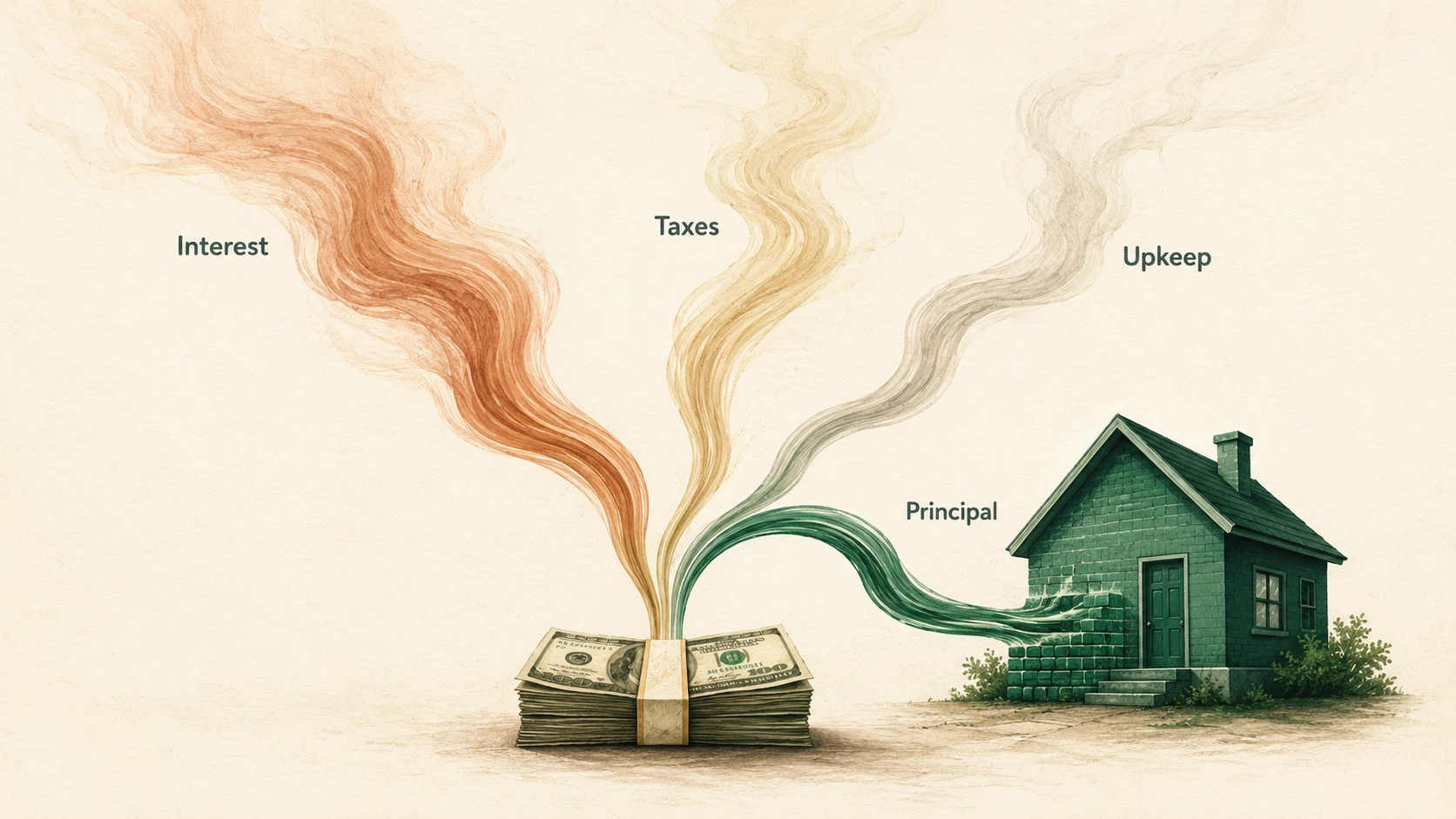
Only the first row buys the house. Everything under it is the cost of holding it, and four of those five rise over time.
Five years in, on a $400,000 loan
Take a $500,000 house with twenty percent down. The loan is $400,000, and at 6.5 percent over thirty years the payment on principal and interest is $2,528.27 **monthly payment **. Across the full term you repay $910,179.52, of which **$510,179.52** is interest. You pay 2.3 times what you borrowed.
The early years are worse than the average, because the schedule charges interest on the balance and the balance is at its highest.
| At | You have paid | Interest | Principal retired | Balance |
|---|---|---|---|---|
| Year 1 | $30,339.24 | $25,868.36 | $4,470.88 | $395,529.12 |
| Year 5 | $151,696.20 | $126,140.26 | **$25,555.94** | $374,444.06 |
| Year 10 | $303,392.40 | $242,497.26 | $60,895.14 | $339,104.86 |
Five years in, you have sent the lender $151,696.20 and reduced what you owe by $25,555.94. Interest took 83 percent of everything you paid.
Now add the exit. Selling costs run six to ten percent of the price for agent commissions, title, and transfer taxes, which on a $500,000 house is $30,000 to $50,000. If a job loss, a divorce, or a parent's illness forces a sale in year five and the market has done nothing dramatic, the sale costs more than every dollar of principal you retired. The down payment comes back. The five years do not.
This is the part the pre-approval conversation never covers.
When renting is the better deal
There is a clean test for it. Ben Felix at PWL Capital proposed the [five percent rule][4]: add roughly one percent of the home's value for property tax, one percent for maintenance, and three percent for the cost of capital, then divide by twelve. On a $500,000 house that is **$2,083 a month** of pure unrecoverable cost, so if you can rent the same house for less than that, renting is the cheaper way to live in it. Point to note, the three percent assumes a real cost of capital, so at today's nominal rates the true figure runs higher for most buyers, which moves the line further toward renting rather than away from it. Renting also keeps you liquid and mobile, and it hands the roof and the furnace to somebody else.
The five piles of cash
So the question is not whether you have twenty percent. The question is whether you have five things at once. On that same $500,000 house:
The down payment. Ten to twenty percent, or $50,000 to $100,000. Twenty percent removes private mortgage insurance, and the saving is larger than it looks. At five percent down the loan is $475,000, the payment is $3,002.32, and total repayment reaches $1,080,838.64. The extra $75,000 saved before closing removes **$170,659.12** from what you repay, and ends PMI before it ever starts.
Closing costs. Three to five percent, or $15,000 to $25,000, covering origination, title insurance, escrow setup, and legal fees. This is separate money. It does not come out of the down payment.
The emergency fund. Three to six months of living expenses, still sitting there the morning after closing. Conventional guidance stops at six months. I funded twelve before I sent a single extra dollar at my own mortgage, because once that fund was complete nothing else competed for the monthly surplus, and that is what made everything after it possible.
Move-in money. The pile nobody budgets. A local move averages about [$1,700][5] and a long-distance move about $4,900 before you have bought anything at all, and then come the utility deposits, the appliances the seller took with them, window coverings for every window in the place, and the first set of tools. Budget three to ten thousand dollars and expect to spend it in week one. This is the pile that ends up on a credit card.
The repair reserve. One to two percent of the home's value a year, or $5,000 to $10,000, held liquid and separate from the emergency fund. The Consumer Financial Protection Bureau tells buyers plainly that the [real cost of a home][6] runs well past principal and interest. The water heater does not check your balance first.
Now the part that matters more than any percentage. A buyer putting five percent down with $60,000 still liquid is in better shape than a buyer putting twenty percent down with an empty account, even though the second one pays less interest over time. The first can absorb a furnace, a layoff, and a tax reassessment in the same year. The second sells at a loss the first time anything goes wrong. Reserves buy time, and time is what keeps you in the house.
One more thing, because it quietly undo all five. Your pre-approval is the largest amount a lender is willing to risk, calculated on gross income, before taxes, childcare, commuting, or a single repair. It is a ceiling, not a recommendation. Size the payment against one income where a household has two, and against take-home pay rather than gross where it has one. Whatever is left over becomes the accelerator, instead of the thing barely keeping you afloat.
Where PayOff Pro comes in
Look at that table again. Interest is the largest unrecoverable cost in the entire purchase, larger than taxes, insurance, and maintenance combined, and it is the only line on the list you can still change after you sign. You cannot negotiate your property taxes in most cases. You can change what the interest costs you.
PayOff Pro does not move your money and it does not connect to your bank. It shows you what your money is doing.
- Your real total. What the loan costs across its whole life, not only what it costs this month.
- Every extra dollar, priced. Enter an extra payment and watch the payoff date move.
- The split. How much of this month's payment buys the house, and how much rents the money.
- Any amount, any month. No biweekly system, no fixed schedule, nothing to keep up with.
No account, no sign-in, no tracking, and your loan stays on your device.
Three things to do before you sign
- Ask your lender for the full amortization schedule. It already exists, they will send it, and almost nobody asks. It shows the lifetime interest total and the month private mortgage insurance comes off.
- Price the five piles against the actual house. Write the five numbers down and total them. If the total is more than you have, you have your answer, and it arrived before the offer instead of after the furnace.
- Run the payment against one income. If it does not survive that test, the house is too expensive, whatever the pre-approval letter says.
The bottom line
You do not control the price of housing, or where rates land, or what the insurance market does, or how hard any of it gets sold to you.
You do control how much cash walks in the door with you, and what you do with the schedule once you are inside. The first decides whether you keep the house. The second decides how long you pay for it.
If you already have a mortgage and want to see what the interest is actually costing you, PayOff Pro runs that math on your iPhone: [Get PayOff Pro for iPhone →][7]
3-day free trial, then $9.99 a year or $2.99 a month. No account required, and your loan stays on your device.
Related articles
- [Is Your Home Really an Investment? The Truth About Owning][8]
- [Home Equity Is Not Idle Money. It Is a Paid-For House][9]
- [Biweekly Mortgage Payments vs. Paying Extra As You Can][10]
Disclaimer: All figures are calculated on a hypothetical $400,000 loan at 6.5 percent over 30 years, and a $475,000 loan on the same terms, covering principal and interest only. They exclude property taxes, homeowners insurance, private mortgage insurance, and lender fees, so your actual payment will be higher. Down payment, closing cost, moving, and repair ranges are national rules of thumb and vary widely by state and by property. Your terms will differ, so verify every number against your own loan estimate before acting. This content is educational and not personalized financial advice, and I am not a financial advisor. PayOff Pro helps you track your mortgage; always verify important financial decisions with your lending institution before acting.
[1]: https://www.nar.realtor/press-releases/first-time-home-buyer-share-falls-to-historic-low-of-21-median-age-rises-to-40 [2]: https://www.opensecrets.org/federal-lobbying/top-clients?year=2024 [3]: https://taxpolicycenter.org/briefing-book/how-did-tcja-change-standard-deduction-and-itemized-deductions [4]: https://pwlcapital.com/rent-or-own-your-home-5-rule/ [5]: https://www.homeadvisor.com/cost/storage-and-organization/hire-a-moving-service/ [6]: https://www.consumerfinance.gov/owning-a-home/ [7]: https://apps.apple.com/app/payoff-pro/id6752794539 [8]: /blog/is-your-home-really-an-investment-the-truth-about-owning [9]: /blog/home-equity-is-not-idle-money-it-is-a-paid-for-house [10]: /blog/biweekly-mortgage-payments-vs-paying-as-you-can